
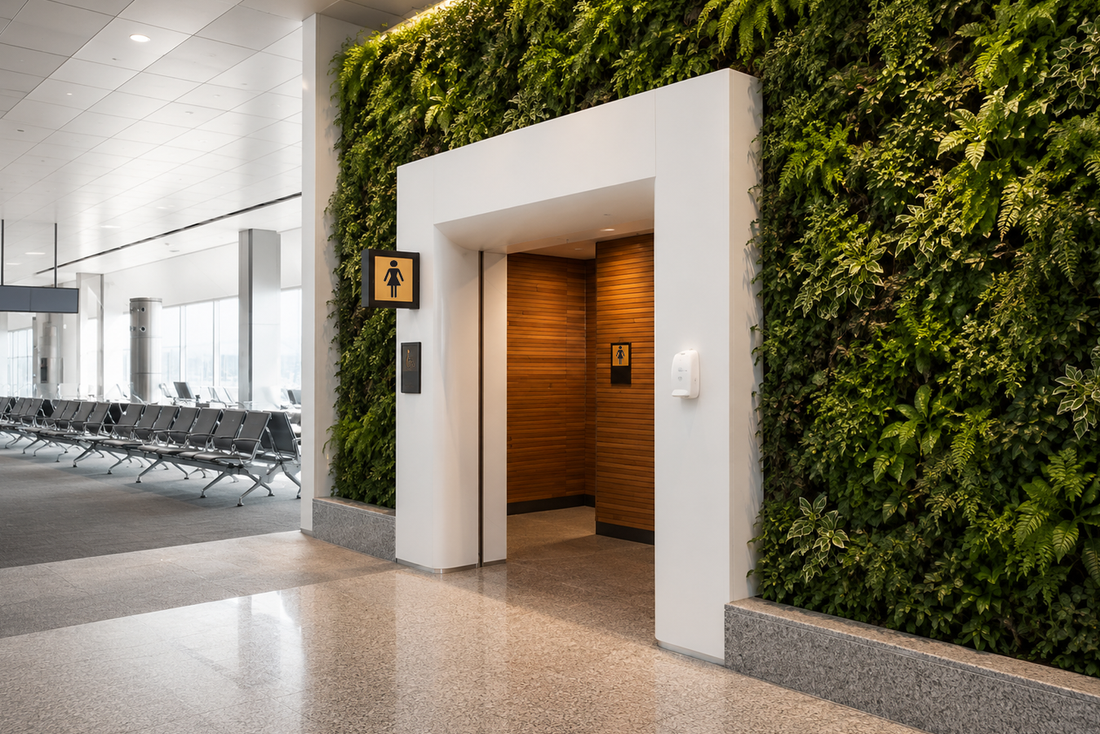
Airport restroom hygiene is a critical operational function in high-traffic terminals where continuous passenger movement, limited cleaning windows, and high expectations for cleanliness converge.
To manage these conditions, Airports prioritize restroom sanitation systems that maintain consistent hygiene under continuous passenger load while minimizing operational dependency on manual intervention.
This article explores the systems, products, and operational practices airports use to maintain cleaner high-traffic restrooms and what facility and procurement teams should consider when evaluating hygiene solutions.
Passenger experience studies across transportation environments consistently identify restroom cleanliness as one of the strongest drivers of traveler satisfaction, influencing perceptions of airport quality, maintenance standards, and overall passenger experience.
|
Quick Answer:
How Do Airports Maintain Washroom Hygiene? Airports maintain washroom hygiene through scheduled cleaning cycles, touchless infrastructure, trained maintenance teams, real-time monitoring systems, and commercial-grade hygiene products. High-traffic airports often prioritize hygiene systems that improve cleaning efficiency, reduce contamination risks, standardize maintenance, and support a better passenger experience. |
Key Takeaways
- High-traffic airports require hygiene systems designed for continuous usage and minimal downtime.
- Restroom sanitation systems influence maintenance efficiency, consumable costs, and passenger satisfaction.
- Touchless infrastructure can help reduce high-touch contamination concerns while improving operational consistency.
- Standardized restroom systems simplify maintenance across multiple terminals.
- Procurement decisions increasingly prioritize durability, scalability, hygiene outcomes, and operational ROI.
Table of Contents
- What Airports Need for High-Traffic Restroom Hygiene?
- Why Airport Restroom Hygiene Is Operationally Challenging?
- What Matters Most in Airport Procurement Decisions?
- Airport Restroom Sanitation Products by Function
- How Airports Typically Choose Between Sanitation Systems?
- How Airport Procurement Teams Should Evaluate Vendors?
- Future Trends in Airport Washroom Hygiene
- Best Practices for Managing High-Traffic Airport Restrooms
- How to Choose Airport Restroom Sanitation Products for High-Traffic Airports?
- Airport Restroom Sanitation Product Evaluation Framework (Procurement Decision Model)
- Conclusion
What Airports Need for High-Traffic Restroom Hygiene?
High-traffic airport restrooms often depend on a combination of sanitation systems, preventive maintenance, and operational monitoring to maintain hygiene consistency during continuous passenger usage. The following checklist highlights common priorities for airport facilities and procurement teams.
- Touchless soap dispensers and hygiene systems
- Scheduled restroom cleaning and inspection cycles
- Consumable refill monitoring and inventory visibility
- High-durability dispensers designed for heavy usage
- Toilet hygiene solutions that support passenger confidence
- Real-time restroom monitoring systems
- Standardized restroom sanitation products across terminals
- Fast-response maintenance workflows during peak traffic
- Staff training for high-volume restroom environments
- Sustainable and maintenance-efficient hygiene systems
Why Airport Restroom Hygiene Is Operationally Challenging?
Maintaining restroom cleanliness in an airport environment is significantly more complex than managing hygiene in traditional commercial buildings. Unlike offices, retail stores, or hotels with predictable occupancy patterns, airports operate in a fast-moving environment where demand fluctuates throughout the day.
For facility managers and operations teams, maintaining consistent airport washroom hygiene requires balancing cleanliness, accessibility, speed, and passenger expectations, often simultaneously.
In major international airports such as Singapore Changi Airport, Dubai International Airport, and London Heathrow, restroom operations are designed around continuous passenger flow, requiring maintenance teams to work in rolling cycles rather than fixed cleaning schedules.
In hub airports, inspection cycles increase during peak departure periods. In high-traffic terminals, refill checks are often aligned with gate-area patrol routes.
Continuous Passenger Traffic Creates Operational Pressure
Airport restrooms experience continuous usage throughout the day, particularly in departure terminals, international transit zones, and peak travel periods. Unlike traditional commercial environments, airport traffic patterns can fluctuate rapidly due to delays, boarding schedules, and seasonal demand.
For operations teams, this increases pressure on maintenance cycles, consumable replenishment, and system durability.
Limited Cleaning Downtime
One of the biggest operational challenges in airports is the limited opportunity for deep cleaning during active hours.
Unlike office buildings or retail environments that close overnight, airports often operate extended schedules without full downtime. Restrooms cannot be shut down frequently without creating congestion or negatively affecting the passenger experience.
This means airport cleaning teams often perform maintenance while facilities remain operational, requiring:
- Fast turnaround cleaning procedures
- Spot cleaning during peak usage
- Scheduled restroom inspections throughout the day
- Efficient coordination between the custodial and operations teams
In many cases, airport restroom maintenance becomes a rolling process rather than a fixed schedule.
Cleaning is often coordinated around flight schedules to avoid passenger disruption.
High-Touch Surfaces Increase Cross-Contamination Risks
Airport restrooms also present unique hygiene risks because of the number of frequently touched surfaces shared by thousands of travelers.
Common high-contact areas include:
- Faucet handles
- Door handles and stall locks
- Countertops and sinks
- Toilet flush systems
- Soap dispensers and hand-drying stations
Without consistent sanitization, these touchpoints can contribute to hygiene concerns in high-traffic public spaces.
For airport operators, reducing high-touch contact points can improve hygiene consistency while reducing cleaning pressure in frequently used restroom zones.
Maintaining Supply Consistency at Scale
In multi-terminal airports, maintaining consistent access to soap, tissue, hand-drying systems, and toilet hygiene solutions can become operationally complex. Standardized consumables and centralized restroom systems can help reduce supply disruptions and simplify maintenance workflows.
What Matters Most in Airport Procurement Decisions?
Airport restroom procurement decisions are primarily driven by one constraint: minimizing operational dependency during peak passenger load conditions.
When systems fail under peak load, the cost impact is not technical, it is passenger experience degradation and emergency maintenance escalation.
This is why airports often prioritize consistency and serviceability over feature richness.
Systems that standardize consumables and simplify servicing consistently outperform feature-rich alternatives.
Passenger perception of cleanliness often becomes the final decision trigger when technical specifications are similar.
Long-term total cost of ownership (TCO), including downtime and labor, outweighs upfront pricing in most airport contracts.
Airports that prioritize only upfront cost over lifecycle maintenance efficiency typically face higher restroom downtime, increased emergency cleaning costs, and inconsistent passenger satisfaction scores across terminals, especially during peak international travel cycles.
Airport Restroom Sanitation Products by Function

1. Hand Hygiene Systems
Operational Constraint: High-Frequency Contact Environment
- Continuous passenger hand usage
- High-touch contamination risk zones
- Rapid refill dependency
Operational Impact
- High consumable turnover rate
- Increased dispenser failure risk under load
- Need for standardized refill systems across terminals
Procurement Decision Criteria
- Durability in high-traffic zones
- Sensor reliability under continuous use
- Refill system standardization across brands
|
Selection Insight:
If airports prioritize low upfront cost, manual systems are often selected, but this increases long-term consumable management complexity and staff workload during peak hours. |
2. Hand Drying Systems
Operational Constraint: Moisture + Congestion Control
- Sink-area bottlenecks during peak hours
- Slip-risk due to wet surfaces
- Variable passenger throughput speed
Operational Impact
- Sink congestion during peak traffic
- Increased cleaning load due to moisture
- Energy vs consumable tradeoff pressure
|
Selection Insight:
Paper-based systems increase replenishment cycles, while high-speed dryers reduce consumable dependency but increase energy and maintenance planning. |
3. Surface Disinfection Systems
Operational Constraint: Fast Turnover Cleaning Windows
- Limited downtime for deep cleaning
- High-touch surface density
- Continuous passenger exposure
Operational Impact
- Faster restroom turnover requirements
- Higher chemical consumption rates
- Need for rapid-dry formulations
|
Selection Insight:
Fast-acting chemicals improve turnaround speed but increase handling complexity and compliance requirements. |
4. Toilet Hygiene Systems
Operational Constraint: Passenger Confidence Gap
- Shared toilet perception issues
- High variability in user hygiene expectations
- Premium vs economy terminal differences
Operational Impact
- Perception-driven cleanliness demand
- Increased need for visible hygiene systems
- Higher reliance on auxiliary hygiene products
Procurement Decision Criteria
- Passenger adoption/usability
- Plumbing compatibility
- Refill + dispenser logistics efficiency
|
Selection Insight:
Systems that improve passenger confidence are often selected in premium terminals, while cost-sensitive airports may avoid them due to lower perceived necessity despite hygiene benefits. |
For airport operators evaluating passenger-facing hygiene solutions, understanding the effectiveness of flushable seat protection systems can support better procurement decisions. Read our guide on Do Toilet Seat Covers Actually Work? to explore the science, limitations, and practical benefits of modern toilet seat cover systems.
5. Consumable Management Systems
Operational Constraint: Supply Continuity at Scale
- Multi-terminal inventory complexity
- Frequent restocking cycles
- Risk of inventory depletion during synchronized arrival waves
Operational Impact
- Restroom downtime due to shortages
- Operational inefficiency across terminals
- Increased procurement coordination load
|
Selection Insight:
Basic refill systems reduce upfront system requirements, but lack of tracking can lead to shortages during peak demand periods. |
When procurement decisions fail to balance cost, maintenance, and passenger perception, airports often experience inconsistent restroom quality across terminals, increased emergency maintenance costs, and negative passenger satisfaction feedback during peak travel periods.
In large hub airports, failure to standardize consumable tracking systems does not just create operational inefficiency, it directly leads to restroom stockouts during peak arrival windows, increased complaint rates, and measurable drops in passenger satisfaction scores within high-density terminals.
In large facilities, maintaining adequate consumable inventory is often just as important as selecting the right sanitation systems. For facilities evaluating large-volume restroom consumables, our guide to Bulk Toilet Seat Covers for High-Traffic Facilities explains how procurement teams approach supply planning, hygiene consistency, and long-term cost management.
How Airports Typically Choose Between Sanitation Systems?
1. If Priority = Cost Optimization
Recommended Systems
- Manual soap + paper systems
- Standard disinfectant programs
- Basic consumable tracking systems
Why
- Lower upfront investment
- Easier procurement cycles
- Reduced technology dependency
Trade-off
- Higher maintenance labor
- Less passenger experience enhancement
2. If Priority = Hygiene Perception (Passenger Experience)
Recommended Systems
- Touchless soap dispensers
- Sensor-based faucets
- Toilet hygiene systems (seat covers / sanitization units)
Why
- Improves visible cleanliness
- Reduces perceived contamination risk
- Stronger passenger confidence
Trade-off
- Higher equipment cost
- More technical maintenance dependency
3. If Priority = Maintenance Efficiency
Recommended Systems
- Centralized consumable management systems
- Smart restroom monitoring systems
- High-capacity dispensers
Why
- Reduces staff workload
- Minimizes inspection frequency
- Improves supply predictability
Trade-off
- Higher system integration cost
- Requires digital infrastructure
4. If Priority = Sustainability Goals
Recommended Systems
- Low-water hand dryers
- Eco-certified consumables
- Flushable hygiene solutions
Why
- Supports ESG targets
- Reduces waste generation
- Improves compliance readiness
Trade-off
- May increase upfront procurement cost
How Airport Procurement Teams Should Evaluate Vendors?
When evaluating sanitation vendors, compare them on:
- System durability in 24/7 environments
- Maintenance and refill efficiency
- Standardization across terminals
- Hygiene performance under peak traffic
- Total cost of ownership (3–5 year view)
Recommended approach: Shortlist 2–3 vendors and test in one high-traffic terminal zone before full rollout.
Vendors that optimize only for product features but ignore maintenance scalability often underperform in long-term airport deployments due to operational scalability limits.
Future Trends in Airport Washroom Hygiene
As airport facilities modernize, procurement and operations teams increasingly prioritize restroom systems that improve efficiency, reduce maintenance burdens, and support long-term hygiene consistency.
Across major international airports, modernization focuses on touchless systems and real-time maintenance visibility. For example, touchless faucet retrofits are now standard in many renovated international terminals
Procurement and operations teams increasingly prioritize three restroom trends that support operational efficiency and long-term hygiene performance:
1. Smart Restroom Monitoring
Many airports are adopting restroom monitoring systems that provide real-time visibility into occupancy, consumable levels, maintenance needs, and cleaning schedules. These systems can help reduce unnecessary inspections while allowing maintenance teams to respond faster during peak traffic periods.
Some high-traffic airports like Dubai International Airport and Changi Airport have explored real-time facility monitoring systems to improve visibility into restroom usage patterns and maintenance requirements during peak travel hours.
Procurement Implication:
- shifts buying from hardware-only systems → software + subscription-based monitoring
- reduces dependency on manual inspection contracts
- increases demand for integrated restroom analytics platforms
- favors vendors offering real-time dashboard + alerts
2. Expansion of Touchless Infrastructure
Touch-free restroom systems continue to expand across airport environments. Sensor-based faucets, soap dispensers, flush systems, and hand-drying solutions can help reduce high-touch interactions while improving restroom efficiency and passenger confidence.
Large transit hubs such as Hamad International Airport and Amsterdam Schiphol Airport have increasingly integrated touchless restroom systems to reduce high-touch contamination points in high-density passenger zones.
Procurement Implication:
- accelerates replacement cycle of manual dispensers
- increases preference for modular, retrofit-compatible systems
- drives standardization across terminals to reduce maintenance complexity
- shifts decision criteria toward sensor reliability + lifecycle cost
3. Sustainability-Focused Hygiene Solutions
Sustainability is becoming an increasingly important factor in restroom procurement decisions. Airports are exploring water-efficient fixtures, energy-saving hand-drying systems, environmentally conscious consumables, and flushable hygiene solutions that align with broader sustainability goals.
Procurement Implication:
- increases the weightage of ESG compliance in vendor selection
- shifts procurement toward low-water / low-waste product systems
- favors vendors with lifecycle sustainability documentation
- impacts long-term contract approvals (especially for international airports)
For procurement teams, future restroom investments increasingly balance hygiene performance, operational efficiency, passenger expectations, and long-term cost management.
Best Practices for Managing High-Traffic Airport Restrooms

Maintaining restroom hygiene in airports requires more than cleaning frequency alone. High-performing airport facilities typically combine preventive maintenance, standardized hygiene systems, operational monitoring, and trained staff to maintain consistency during heavy passenger traffic.
In airport terminals with continuous passenger movement, restroom performance often depends on preventive systems rather than reactive cleaning alone.
The following practices are commonly prioritized in high-traffic airport environments.
1. Conduct Frequent Restroom Inspections
Proactive inspections help reduce service disruptions before they affect passenger experience. In high-traffic airports, restroom inspection frequency can directly influence cleanliness consistency, consumable availability, and maintenance response times.
Why It Matters Operationally
- Prevents supply shortages before complaints occur
- Helps identify spills or maintenance issues early
- Improves restroom consistency during peak traffic periods
What Procurement Teams Evaluate
Airports increasingly evaluate monitoring systems that support inspection scheduling, maintenance alerts, and operational visibility across terminals.
2. Standardize Airport Restroom Sanitation Products
In high-traffic airport environments, standardized restroom systems can improve maintenance efficiency and reduce operational inconsistency across terminals. Using compatible sanitation products may simplify training, replenishment, and servicing.
Why It Matters Operationally
- Improves maintenance consistency
- Simplifies staff training
- Reduces supply management complexity
- Helps maintain hygiene standards across multiple restroom zones
What Procurement Teams Evaluate
Procurement teams often prioritize restroom sanitation products that balance durability, refill compatibility, maintenance efficiency, and long-term operating costs.
3. Prioritize Touch-Free Hygiene Systems
Touchless infrastructure is increasingly used to reduce high-touch interaction in busy restroom environments. In airports, touch-free systems can support better hygiene consistency while helping maintenance teams reduce cleaning pressure around frequently used areas.
Why It Matters Operationally
- Reduces shared touchpoints
- Improves restroom flow during busy hours
- Supports stronger hygiene perception among travelers
- May reduce cleaning demand around sinks and flush systems
What Procurement Teams Evaluate
Selection often depends on reliability, maintenance requirements, installation compatibility, and long-term usability in high-volume facilities.
4. Maintain Consistent Consumable Availability
Even well-maintained restrooms can negatively affect passenger perception when basic supplies run out. High-traffic airports often implement systems that improve refill visibility and reduce supply interruptions during peak periods.
Why It Matters Operationally
- Reduces restroom complaints
- Prevents service disruptions
- Supports consistent hygiene standards
- Improves restroom usability during peak traffic
What Procurement Teams Evaluate
Procurement teams frequently assess consumable systems based on refill efficiency, storage requirements, supplier reliability, and long-term operating costs.
5. Train Teams for High-Stress Passenger Conditions
Restroom hygiene performance depends not only on products and systems, but also on operational execution. Airport maintenance teams often work under limited downtime and continuous passenger flow, making training essential for maintaining consistency.
Why It Matters Operationally
- Improves response speed
- Supports hygiene consistency across shifts
- Reduces operational errors
- Helps staff manage high passenger volume more effectively
What Procurement Teams Evaluate
Airports often favor restroom systems that simplify staff training and reduce operational complexity across multiple terminals.
6. Monitor Restroom Performance Continuously
Many airports use passenger feedback, inspection data, and operational reporting to identify recurring hygiene issues and improve restroom performance over time. Monitoring performance can help maintenance teams respond faster and improve resource allocation.
Why It Matters Operationally
- Identifies recurring cleanliness concerns
- Helps prioritize high-traffic restroom zones
- Improves maintenance planning
- Supports better operational decision-making
What Procurement Teams Evaluate
Restroom technologies that provide maintenance visibility and performance tracking are increasingly becoming part of airport restroom planning.
7. Design for Passenger Hygiene Confidence
In airport environments, hygiene performance is influenced not only by cleaning standards but also by passenger perception. Restrooms that visibly support cleanliness, touch-free interaction, and hygiene reassurance can improve traveler confidence during use.
Why It Matters Operationally
- Supports positive passenger perception
- May reduce hygiene-related complaints
- Improves restroom experience in premium terminals
- Reinforces airport cleanliness standards
What Procurement Teams Evaluate
Some airport operators may evaluate hygiene-supporting systems such as touch-free infrastructure, seat sanitation systems, or LooREADY flushable toilet seat cover solutions depending on traveler expectations and restroom usage patterns.
For airport operators and procurement teams, maintaining restroom hygiene increasingly depends on systems that support operational consistency, maintenance efficiency, and passenger confidence. Combining standardized sanitation products, trained staff, preventive inspections, and monitoring systems can help airports maintain cleaner restroom environments despite continuous passenger traffic.
How to Choose Airport Restroom Sanitation Products for High-Traffic Airports?
Selecting restroom hygiene systems for high-traffic airport environments involves more than product availability or upfront cost. Procurement teams often evaluate airport restroom systems based on operational efficiency, maintenance requirements, passenger experience outcomes, and long-term performance under continuous usage conditions.
In high-traffic airport environments, sanitation product selection can influence maintenance workload, consumable usage, restroom downtime, staffing efficiency, and long-term operational cost. As a result, procurement decisions are often evaluated through a total cost of ownership lens rather than upfront purchase price alone.
| Procurement Factor | Why It Matters in Airports |
|---|---|
| Durability | Products must withstand continuous passenger usage. |
| Maintenance Requirements | Lower servicing needs reduce operational interruptions. |
| Consumable Compatibility | Standardization simplifies inventory and replenishment. |
| Hygiene Performance | Supports sanitation consistency during peak traffic. |
| Passenger Perception | Influences traveler confidence and restroom satisfaction. |
| Sustainability | Helps support environmental and compliance goals. |
| Total Cost of Ownership | Reduces long-term operational expense. |
Airport Restroom Sanitation Product Evaluation Framework (Procurement Decision Model)
1. Operational Durability (High-Traffic Resilience)
Products must withstand continuous passenger usage in 24/7 airport environments without frequent failure or replacement.
2. Maintenance Efficiency (Downtime Reduction)
Solutions should reduce servicing time, simplify cleaning cycles, and minimize restroom downtime during peak hours.
3. Hygiene Performance (Contamination Control)
Systems must reduce high-touch exposure and maintain consistent sanitation standards across all terminals.
4. Consumable & System Standardization
Unified refill systems and compatible dispensers help reduce supply disruptions and simplify inventory management.
5. Passenger Experience Impact
Restroom systems must improve visible cleanliness, usability, and hygiene confidence for travelers.
6. Total Cost of Ownership (TCO)
Procurement decisions must evaluate lifecycle cost including labor, refills, maintenance, and replacement cycles.
7. Sustainability & Compliance Alignment
Modern airports increasingly prioritize water efficiency, waste reduction, and environmentally aligned hygiene systems.
Conclusion
Maintaining restroom hygiene in airports requires more than cleaning frequency alone. In high-traffic environments, restroom performance increasingly depends on standardized sanitation systems, preventive maintenance, trained staff, and airport restroom sanitation products designed for continuous passenger usage.
As airport infrastructure modernizes, sanitation systems are increasingly evaluated as long-term operational assets rather than facility consumables.


